Molina and Valentin’s relationship
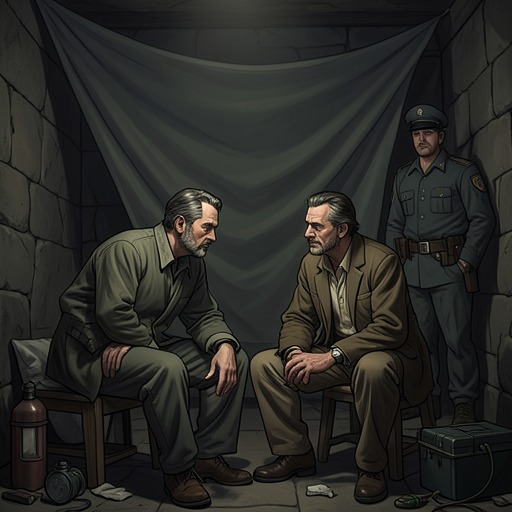
Kiss of the Spider WomanMolina and Valentin’s relationship is shaped by an unlikely exchange: one man’s commitment to political struggle and the other’s need to tell and share films. Their cell confines them together, but conversation gradually makes that confinement a space where they can question one another, negotiate how to behave, and offer forms of attention unavailable beyond its walls. After Valentin’s death, Molina’s recollection of their nightly storytelling gives the relationship its final measure: the stories had become a kind of lullaby, and the silence left behind is painful.
Shared Cell, Unequal Commitments
Valentin describes political action as the organizing purpose of his life. He says he can endure the conditions of prison because they serve a larger end, social revolution, and because political struggle matters more to him than sensual gratification. He places his endurance within a collective commitment rather than presenting it as an isolated act of will. When the possibility that he is alone is raised, he insists that he remains connected to his comrades and to others who share the struggle, even when he cannot see them. The image of a thread that might slip from his grasp but that he has now recovered makes that solidarity a continuing effort, not an abstraction.
Molina describes a different kind of helplessness. Like Valentin, he feels unable to act from inside the cell, but the person he worries about is his sick mother, not a woman or girlfriend. She is with his aunt, yet Molina remains troubled by her high blood pressure and weak heart. Their concerns therefore do not begin as equivalent: Valentin speaks from political obligation and collective purpose, while Molina speaks of family vulnerability and the pain of being unable to help. The contrast gives their conversations a real point of friction, but it also lets each man disclose what matters beyond the immediate routine of the cell.
Movie Stories Become a Shared Practice
The films Molina recounts are not merely a monologue imposed on a captive listener. Valentin says he likes the pictures and wants the opportunity to chime in rather than sit silently through hours of narration. He also acknowledges that listening helps the time pass and can put him to sleep. Their exchange contains both affection for the stories and irritation about how they are told: laughter at a moment Molina considers serious angers him, while Valentin explains that he wants to take part in the telling. The small disagreement matters because it establishes a pattern in which listening becomes reciprocal only when Valentin can question, interrupt, or add something of his own.
Molina’s account of a Paris music hall shows what Valentin is being invited to enter. The description moves from a dark-velvet theater and chrome railings to a chorus whose costumes appear to change as the dancers turn. Then a woman in a close-fitting silver lamé gown emerges through layers of tulle and descends a staircase revealed by successive flashes of light. A handsome German officer watches from a box. Molina’s narration reconstructs the scene through theatrical setting, costume, movement, and lighting; Valentin’s interruptions, including a question about a material used for costume jewelry and a request to continue the plot, make the imagined screening a conversation rather than a finished performance.
Other film sequences show the breadth of this shared imaginative space. One begins as the Mardi Gras of Veracruz approaches dawn, with fishermen hearing music from a brightly lit villa and a masked couple remaining on the dance floor. In another late sequence, a silver-clad woman appears in a jungle film image, caught in a web that seems to grow from her own body. These scenes differ in setting and mood, but their retelling gives the men a repeatable way to exchange attention: Molina supplies images and narrative momentum, while Valentin responds, asks, and sometimes redirects him. The films thus become both an escape from the cell’s limited surroundings and a medium through which the two men can remain in contact.
Curiosity, Friction, and a Different Kind of Freedom
Valentin’s questions also turn from the films toward Molina himself. He says that he wants to understand his cellmate better and admits that he knows little about people with Molina’s inclination. That effort to understand does not erase awkwardness. At one point the discussion becomes insulting and strained, and one of them asks that their conversation remain at a certain level; the exchange then returns to the familiar complaint that they speak most easily when discussing films. The relationship is not presented as effortless understanding. It advances through questions that risk offense, attempts to set limits, and the shared subject to which they can return.
Valentin later describes their relationship within the cell as something they can shape for themselves, without pressure from other people. He compares their situation to being alone on a desert island for years: oppressors may exist outside, but, as he frames it, neither man oppresses the other inside. What unsettles him is the possibility that someone might be kind without expecting anything in return. This description makes the cell’s apparent privacy morally complicated. Their surroundings remain carceral, yet Valentin imagines a small space in which their conduct toward each other need not reproduce the coercion outside it. The relationship’s significance lies partly in that contrast between the institution’s control and the possibility of choosing how to treat one another.
Intimacy, Loss, and the Stories That Remain
After a night that changes their relationship, the conversation turns to regret. Molina says he has none and increasingly regards sex as innocence itself; when he is asked about a remedy, he says he will study. The restrained exchange places intimacy beside ordinary habits of coping rather than treating it as a separate, fully explained resolution. Elsewhere, a moment of silence prompts one of them to ask what is wrong and to ask the other not to turn away. Together, these moments register a growing attentiveness, while leaving the men’s feelings neither simple nor entirely spoken.
The relationship’s ending is recalled through Molina’s response to news that his cellmate died in a shootout. In the final film-like sequence, Molina recounts an exchange with his mother in which she asks whether the reports are true and whether he brought Valentin bad luck. Molina accepts that he feels responsible and sad, but says only Valentin could have known whether he was happy to die for a just cause; even Valentin may not have known. Molina then names the absence that has become part of his own life: he can no longer invite Valentin to dinner, as Valentin had invited him, and he can no longer hear the films he told night after night. Those stories had worked like lullabies in the cell. Their loss makes clear that the bond was sustained not only by political discussion or intimacy, but by the recurring act of telling and listening; after Valentin is gone, Molina’s narration keeps that practice alive as both memory and grief.